Recently a former US President decried the spread of ‘misinformation.’
He didn’t mean the hundreds of people who lied over two years every night about fake “Russian collusion.”
He didn’t mean the correspondents who called the 2020 summer riots ‘mostly peaceful.”
He didn’t mean the multitude of constant lies and accusations (never proven) about the 45th POTUS.
He didn’t mean the 51 former and current intelligence officials that called Hunter Biden’s laptop “Russian disinformation.”
He didn’t mean the folks who characterized the Florida bill as “Don’t Say Gay.”
He didn’t mean the folks who promote Critical Race Theory lying about the contents of school text books.
He did mean the increasing number of people talking about the evidence of harmful side effects of the COVID-19 vaccines.
He did mean anything challenging the absolute authority of the Federal government for lockdowns, mask mandates, etc.
He did mean any information indicating the Biden family is engaged in criminal behavior.
He did mean anything inconsistent with his narrative.
As though American citizens are incapable of thinking for themselves, they believe someone must decide for them.
This is an example of ‘thought control.’ It is used in authoritarian regimes to control the population, such as the People’s Republic of China and Russia.
Russian and Chinese leaders control the media in their countries and if somehow something slips through their net, prison time or worse is accorded to the offender. Control over the media is not yet complete here, but calls for the non-conforming information sources to be silenced are frequently heard. Social media companies routinely remove content not matching their narrative and remove repeat offenders from their platforms.
If their narrative is so flimsy as to be incapable of standing up to criticism, it is obvious what the game plan is.
Fortunately, we have elections to toss the authoritarian wannabes out of office and I vote.
Recently in the great State of Florida a law was signed by Governor DeSantis. One provision of the bill sparked outrage:
3. Classroom instruction by school personnel or third parties on sexual orientation or gender identity may not occur in kindergarten through grade 3 or in a manner that is not age-appropriate or developmentally appropriate for students in accordance with state standards.
As a parent and grandparent, I am amazed a law was needed to state the obvious. Children’s upbringing is a parental responsibility and any discussions about gender identity or sexual orientation should originate in the home with the parents or guardians of the child. Why is there a need to discuss sexual orientation or gender identity with five to seven year old children in school without the participation of the parents? Although the US population believes almost a quarter of the population is gay, actually polling has indicated the figure is closer to 4.5%.
Using the pejorative “Don’t Say Gay” to rename the bill, the opposition has released statements, held rallies and even had three individuals continually repeat the word ‘gay’ at some awards show. The Disney corporation should be ashamed that it has taken the position:
It’s “goal as a company is for this law to be repealed by the legislature or struck down in the courts, and we remain committed to supporting the national and state organizations working to achieve that.”
Walt Disney is rolling over in his grave. The same month pedophile Disney employees are arrested, the once family safe place wants to ensure five through seven year-old Florida students can be lectured on gender identity and sexual orientation in an uncontrolled environment without parental input.
btw, despite all the negative political attacks, the name of the bill is “Parental Rights in Education” and there is no “Don’t Say Gay” in the bill. The attacks on Gov. DeSantis and the bill just might be due to the upcoming Florida’s Governor Race or the push-back against unconstitutional vaccine mandates.
I am sure everyone has at least seen the notification of ‘misinformation’ on social media posts. Sometimes, the ‘misinformation’ is declared due to slight errors, is satirical, or because someone didn’t like it.
The attack on certain thought is everywhere. Whether the algorithm keeps the audience low or users are placed in Fazebook jail or just removed from the platform, the ‘bad’ ideas are quickly censored.
On the other hand, Wikipedia usually corrects errors quickly due to the plentiful number of editors. Discussions are held and interested parties vote to resolve issues. However, something happened, and it does not look good.
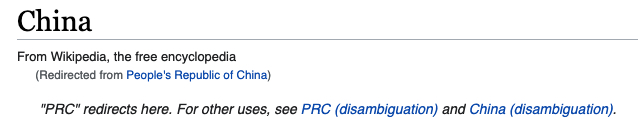
The Wikipedia entry for the “People’s Republic of China” does not exist, or more importantly, redirects to the “China” entry.
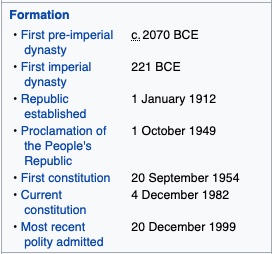
Along the right side of the page, the page shows the first entry under “Formation” to be 2070 BCE.
The implication is the ruling Chinese Communist Party claims all the territory they currently control as being ‘Chinese” for the past 4,092 years. Any historian not under the control of the Chinese Communist Party knows this is wrong. The rise of a single monolithic Chinese culture from the Yellow River area is no longer cited in modern histories; but is one of a few cultures that rose in Asia to form what is today called China. This doesn’t even cover two-thirds of the country that until less than 200 years ago were considered ‘barbarians’ and not ‘Chinese.’
I wish this was the only example, but it probably isn’t.
Bad on Wikipedia for letting this happen, but one way to fight back is to confront the wu mao dang (50 cent army) with facts and reverse this travesty.
“Its only publicly documented activities have been transfers of $23 million to U.S. environmentalist groups that push policies that would hamstring surging American oil and gas production, which has hurt Russia’s energy-reliant economy.”
Klein Ltd. is linked to Russian Oil companies in the article above from 2015.
Russia’s reliance on energy as the foundation of its economy is the reason. The reduction of oil prices due to fracking in the United States was a huge blow. So, they sent money to the U.S. environmental groups to end fracking.
A more recent article (Russian-linked groups donated to anti-frakking Green groups because they love the planet right?) from March 2022, indicates:
The SeaChange Foundation, in San Francisco has apparently given out “about $400 million” between 2007 and 2015 to “environmental groups that have worked to block fracking and pipeline construction that make natural gas development and distribution possible.”
I remember one of the first orders of business for the Biden administration was to end U.S. energy independence.
The ‘green’ folks have lied to us about climate change for years. Their alarming predictions have not come true and now we know who is paying them to keep saying these things to hamstring the U.S economy.
“Go green,” they say, thinking all our energy needs will run on solar or wind generated power.
“Stop all U.S. oil production,” they chant, thinking their green options will keep our country clean and strong when in actuality it is a security concern. One volcano exploding in some remote corner of the world could end the use of solar panels for a year or years and what do we use then? How would all the electric cars be recharged in traffic jams caused by blizzards or evacuations? Imagine ten or twenty miles of electric cars filled with frozen people.
And who would we rely on in case of an energy shortage/emergency? The one country that has not decided to go green, Russia.
And how much will they charge us then?
Watching a grandson’s new AI robot the other day brought some concerns to mind.
I knew the little toy did not have enough memory to be able to use the artificial intelligence features without connecting to wifi. Therefore, the information from the various sensors (audio input and output, camera, distance measurement, etc.) could send an enormous amount of information about its surroundings back to some location. While most people would not be concerned, some folks would not wish for their conversations, or the products they use, or the layout of their house to be available to unknown parties.
While recording the sounds in your home, the AI robot can document the hours people are active in the home or find out when the family is away on vacation.
Imagine while mapping their surroundings, the AI robot notices a can of shoe polish and the next week, the owner’s email gets spammed with offers for shoe polish or shoe polish applicators. Or the AI robot notices a certain brand of television and emails for add-on accessories start arriving in your inbox.
A greater concern would be the mapping of your home – the location of high-ticket items or security features would be recorded somewhere and could be sold or hacked to allow someone to burglarize your home from the information provided by the AI robot.
Do I have any evidence of actual examples? No; however, it is only a matter of time before it starts.
So what can a person do about it?
My thought is to introduce the robot to a closed environment at first, such as a cardboard box. It could be partitioned with cardboard walls, fake windows and doors. Placing pictures of family members inside the environment will help the robot find and identify faces. Let the robot scan and map the entire environment until it gets bored. Randomly, allow the robot to pass through one of the doors to either an add-on environment or loose into your home; however, pay close attention to how the robot reacts when allowed to roam freely. At first, keep all the internal doors in your home closed to restrict movement (and scanning.) When the first outing is complete, return the robot to the original environment for a few days. The next time the escape hatch is opened, open one of the home’s internal doors and see if the robot makes a beeline to check out the new open area to explore or how the robot’s behavior changes (if there is any change from previous ‘escapes’.)
The more complex the environment, the more useless data the robot absorbs before providing real data about your home. Adding a computer monitor behind ‘windows’ can provide scenes of rainfall interrupted by snowy blizzards or underwater scenes replaced by mountains will further confuse the data set captured by the robot. I would also suggest the environment contain a ‘honey pot.’ This could be an image of a pile of gold or stack of $100 bills, appropriately sized, of course. I would not allow the robot to leave the ‘space’ for a week or two with the honey pot in place. If someone is looking at the robot’s data and becomes interested in the ‘easily obtainable loot,’ it will not take long for them to notice and maybe visit. Extra vigilance will be necessary, but at least you will know.
It does represent a lot of work to create the environments; however, the robot’s potentially nefarious behavior will be identified.